If People Vanished From New York City, This Is What Would Take Over

Scientists say nature would reclaim the city in unexpected ways.
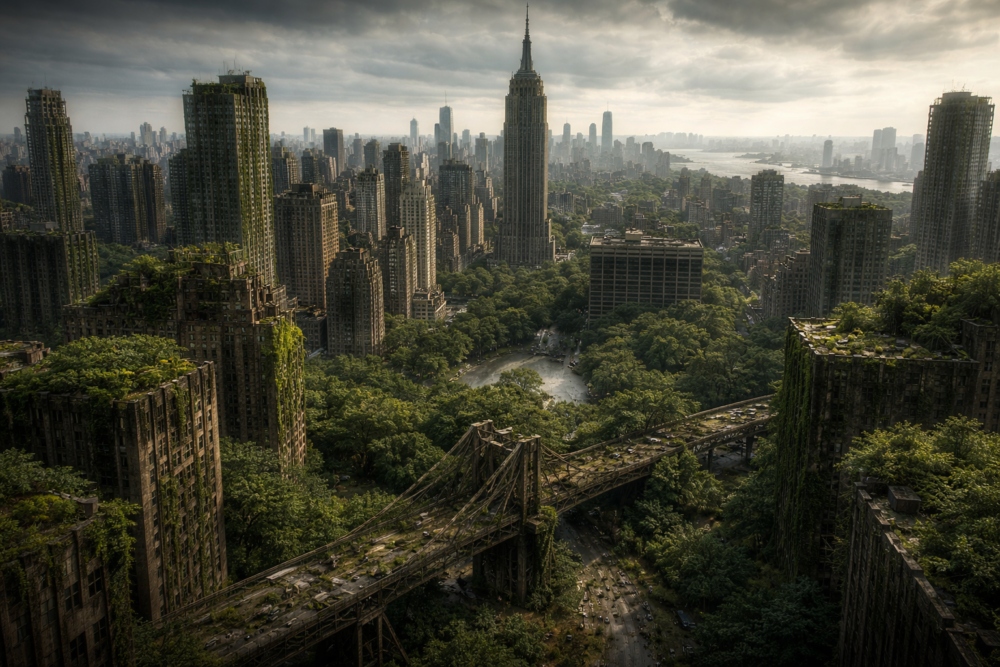
©Image license via Planet Sage/Chat GPT

Imagine New York City without people. No traffic, no maintenance crews, no lights switching on at dusk. At first, the city would look frozen in time, almost intact, like a paused movie scene waiting for someone to press play.

But cities only function because humans constantly hold them together. Pumps move water, power keeps systems dry, and repairs stop small failures from spreading into disasters. When that attention disappears, the systems that make the city livable begin to unravel.

Researchers who study abandoned cities, ecology, and infrastructure say New York would not stay empty or stable for long. Nature, weather, and decay would move in quickly, reshaping the city in ways that feel dramatic, uneven, and surprisingly fast.

Read more

Why One U.S. State Is Emerging as America’s Top Relocation Choice

New migration data shows jobs, affordability, and lifestyle are quietly reshaping where Americans move.

©Image license via Canva

A lot of people feel “stuck” where they are—prices up, paychecks stretched, and job moves harder to justify. So when one state quietly starts topping inbound-move rankings, it grabs attention, even if you’ve never considered living there.

This surge comes from a national moving-company study that tracks where its customers relocate. In the latest report, one West Coast state rose to No. 1 for inbound moves—driven largely by job seekers and people chasing a lower day-to-day cost.

It’s not a perfect snapshot of all migration, but it does reveal what today’s movers are prioritizing: work, affordability, and a place that still feels livable.

Read more

Say Goodbye to Cement? A New Eco-Friendly Material Might Replace It

How a lower-carbon material could change the future of construction.

©Image license via Planet Sage/Chat GPT

Cement and concrete are everywhere: in sidewalks, skyscrapers, bridges, and roads. But producing cement is one of the biggest industrial sources of carbon emissions on Earth, responsible for roughly 7–8 percent of the global total.

That’s why scientists and engineers are racing to find alternatives that are stronger, greener, and cheaper. New materials made from recycled waste, earth, bio-based materials, and carbon-capturing methods could do more than cut emissions. They may reshape how we build our cities and homes.

These innovations range from carbon-negative binders to ancient techniques reimagined for the 21st century. The race to replace cement isn’t about novelty but about necessity.

Read more

Think the World Is Falling Apart? Science Says Not So Fast

Research shows long-term progress in places most people assume are declining.

©Image license via Canva

It’s easy to feel like everything is falling apart. Your feed is built for outrage, bad news travels faster than good news, and our brains remember threats more than quiet progress. So pessimism can feel like realism.

But when researchers zoom out, a surprising pattern appears: in several big ways, the world has gotten healthier, safer, and more educated over the long run—even if recent years have brought real setbacks.

The trick is holding both ideas at once. Problems are serious and deserve attention. At the same time, the data shows humans have solved more than we give ourselves credit for.

Read more

Archaeologists Find An Ancient Stone Wall Underwater That’s Rewriting History

The submerged structure off France’s coast is forcing scientists to rethink early human activity.

©Image license via Planet Sage/Chat GPT

Off the Finistère coast of Brittany, divers surveying a submerged plateau near the Bay of Audierne ran into something that feels wrong in the best way: a straight, human-made stone wall hiding under the waves for thousands of years.

It lies roughly 9 meters down today, but it was assembled when sea levels were far lower and the shoreline sat much farther out, turning this spot into walkable ground.

Dating work places it around 5800–5300 BCE, older than many famous megaliths on land, and its scale has researchers arguing over whether it was protection, a trap, or something we have not named yet.

Read more

Why So Many People Still Love Living in California

Why the appeal hasn’t faded, even as challenges grow.

©Image license via Canva

Living in California often means holding two truths at the same time. People complain openly about housing costs, traffic, taxes, wildfires, and long commutes, sometimes all in the same breath. Those frustrations are real and increasingly hard to ignore.

At the same time, many of those same people say they can’t imagine living anywhere else. The attachment isn’t about denial or loyalty. It’s about how daily life still feels once you factor everything in.

For many residents, California offers a mix of environment, opportunity, and cultural energy that remains difficult to replace. The problems are obvious, but the overall experience still feels worth the tradeoff.

Read more

These Are The Things People Get Wrong About Canada All the Time

From weather to culture, these assumptions don’t hold up once you look closer.

©Image license via Canva

People online love turning Canada into a single vibe instead of an actual place. A few jokes about snow, politeness, and maple syrup get repeated until they start sounding like facts. But Canada isn’t one mood or lifestyle.

It’s a mix of cities, regions, languages, and cultures that don’t match the meme version. Some stereotypes are harmless, but others erase real differences, especially between provinces and big cities.

Once you look closer, a lot of the “common knowledge” falls apart, and the real country looks more interesting, more complicated, and sometimes more surprising than the stereotype.

Read more

DoorDash vs Uber Eats: Which One Is Cheaper and Faster in 2026?

The small differences that decide which app gives better value.

©Image license via Canva

Food delivery looks effortless, but the price and timing behind each order are anything but simple. Every tap triggers algorithms that decide fees, driver routing, and how quickly your food moves from kitchen to door.

By 2026, DoorDash and Uber Eats dominate most U.S. cities, yet many users still feel surprised by totals and delivery times. That confusion isn’t accidental. Each app nudges behavior in different ways.

Once you understand how those systems work, food delivery stops feeling random. The differences between these two apps add up fast, and knowing where they diverge can save real money and time.

Read more

These Little Packets You Always Throw Away Are More Useful Than You Think

These tiny packets fight moisture damage in more places than most people realize.

©Image license via Canva

Most people spot silica gel packets, glance at the “Do Not Eat” warning, and toss them without a second thought. They feel disposable, mysterious, and slightly suspicious, like packaging filler with no real purpose once the box is opened.

But those tiny packets exist for a reason. Silica gel is designed to control moisture, and moisture is responsible for far more everyday damage than most people realize. That quiet role is why manufacturers keep slipping them into everything.

Once you understand what silica gel actually does, throwing it away starts to feel like a missed opportunity. These small packets can solve everyday problems you may not even know are caused by moisture.

Read more

Gen Z Has Near-6-Figure Debt and Their Radical Money Strategy Might Surprise You

How “disillusionomics” is pushing young adults to build multiple income streams to survive today’s economy.

©Image license via Canva

Gen Z didn’t invent student debt, high rent, or unstable job markets, but they’re living with all three at once. For many young adults, the traditional promise of a single career leading to financial stability simply hasn’t held up.

Instead of waiting for the system to work, some are rebelling quietly. They’re piecing together income from side hustles, freelancing, online businesses, and part-time work, turning financial survival into a kind of strategy.

The trend has a name, disillusionomics, and it reflects a generation that no longer trusts old economic rules. Faced with near-six-figure debt, Gen Z isn’t giving up. They’re redesigning how money fits into everyday life.

Read more