Archaeologists Uncover One of Britain’s Largest Celtic-Era Treasure Troves in North Yorkshire

More than 800 Iron Age artifacts—including chariots, ceremonial spears, and tools—have been unearthed at a vast Celtic-era site in North Yorkshire.

©Image license via Chat GPT

Archaeologists in North Yorkshire have uncovered one of Britain’s largest collections of Iron Age artifacts, revealing extraordinary details about life and ritual during the Celtic era. The excavation yielded over 800 items, including chariot fittings, weapons, and intricate metalwork believed to date back more than 2,000 years. Researchers say the discovery offers rare insight into the customs and craftsmanship of Iron Age communities, suggesting the area was a thriving ceremonial center long before the Romans reached Britain.

Read more

Discovery of Ancient Stone Megastructures Reveal Europe’s Earliest Organized Hunting System

New LiDAR scans reveal vast stone funnels once used by prehistoric Europeans to trap wild herds.

©Image license via Chat GPT

Archaeologists have uncovered massive stone megastructures hidden beneath the forests of the Karst Plateau along the Slovenia–Italy border, revealing Europe’s earliest large-scale hunting system. The funnel-shaped walls, stretching up to 3.5 kilometers, were designed to channel herds of red deer into pits or enclosures. Built before the Late Bronze Age, these structures show that prehistoric Europeans hunted cooperatively on an organized, landscape-wide scale—comparable to systems once thought unique to ancient communities in the Middle East and North Africa.

Read more

New Evidence Emerges That Could Rewrite the Story of Cleopatra’s Reign

New excavations in Egypt reveal artifacts from Cleopatra’s era, offering fresh insight into her reign.

©Image license via World History Encyclopedia

New discoveries along Egypt’s northern coast are offering a clearer picture of life during Cleopatra VII’s reign. Excavations near the ancient city of Taposiris Magna—where Cleopatra is believed to have worshipped and possibly sought refuge—have revealed coins, statues, and temple foundations dating to her rule. These findings shed light on the political and religious climate of late Ptolemaic Egypt, a period marked by alliances with Rome, internal unrest, and the enduring power of one of history’s most enigmatic queens.

Read more

If Civil Unrest Erupts, These American Cities Could Become Unrecognizable Overnight

Analysts say some U.S. cities could face rapid collapse if widespread unrest overwhelms vital systems.

©Image license via Wikimedia Commons

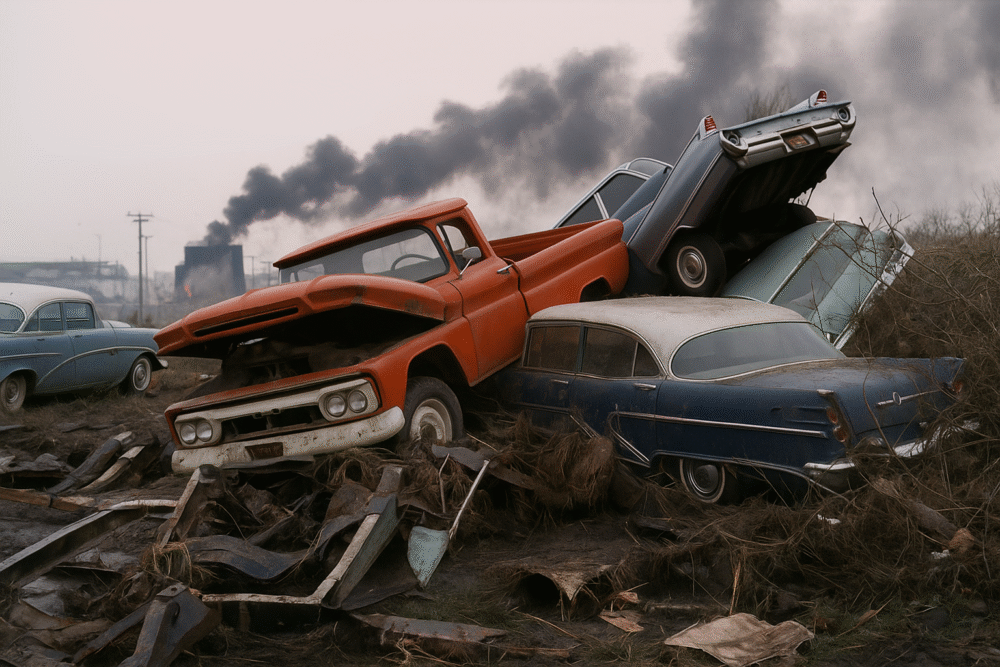
A new analysis of urban infrastructure, population density, and social vulnerability suggests that some American cities could change dramatically within hours if widespread civil unrest were to erupt. Experts point to factors like aging power grids, limited evacuation routes, and deep political divisions that could turn demonstrations into cascading crises. While researchers stress that such scenarios are unlikely, they warn that recent years have revealed just how fragile modern cities can become under extreme social pressure.

Read more

Did Easter Island’s Famous Statues Really ‘Walk’ Into Place? New Research Suggests They Might Have

New research suggests Easter Island’s towering moai really did “walk” — with a clever engineering twist.

©Image license via PickPik

For centuries, the Polynesian people of Easter Island told European explorers their giant statues “walked” — a claim long dismissed by scholars. But new experiments and physics-based modeling are breathing life into that legend. Researchers have now moved a replica moai upright for 300 feet in just 40 minutes using a rope-rocking method, and they argue that ancient builders engineered the statues to tilt forward slightly, enabling controlled side-to-side rocking. If accepted, this may rewrite how we understand ancient engineering on Rapa Nui.

Read more

The Surprising Role of Lead Poisoning in Humanity’s Rise Over Neanderthals

New evidence suggests early humans’ tolerance to lead may have given them an evolutionary advantage.

©Image license via World History Encyclopedia

A new study reveals that early humans may have survived toxic lead exposure better than Neanderthals—an unexpected twist in our shared evolutionary story. By analyzing ancient teeth and bones, researchers found traces of lead suggesting both species lived near contaminated sites. But modern humans seemed to handle the exposure with fewer long-term effects. Scientists think this resilience could have provided a hidden survival edge, helping our ancestors adapt to harsh environments while Neanderthals gradually disappeared.

Read more

A Deep-Sea Discovery May Finally Solve the Amelia Earhart Mystery

Sonar scans reveal a plane-shaped object deep in the Pacific, renewing hope of solving Earhart’s mystery.

©Image license via Canva

Nearly nine decades after Amelia Earhart vanished during her 1937 flight around the world, a new underwater discovery may offer the most promising lead yet. Deep-sea sonar scans captured by marine exploration company Deep Sea Vision show what appears to be a plane-shaped object resting nearly 5,000 meters below the Pacific Ocean’s surface. The find lies west of Howland Island—the same area where Earhart was last heard from—renewing global hopes that her long-lost Lockheed Electra may finally be found.

Read more

Could This Turkish Cave Be a Lost Christian Sanctuary? Rare Jesus-Paul Fresco Stirs Debate

Archaeologists in Cappadocia uncover a cave depicting Jesus and St. Paul, sparking historical debate.

©Image license via Chat GPT

A newly restored cave near the ancient city of Syedra in southern Turkey is capturing international attention for what lies within its walls. Decorated with Byzantine-era frescoes depicting St. Paul and a possible image of Jesus Christ, the site may have served as a baptismal cave between the 5th and 7th centuries A.D. The discovery offers a vivid look at early Christian worship in Anatolia’s countryside, where faith, art, and community merged far from the grand basilicas of the empire.

Read more

AI Just Decoded a 2,000-Year-Old Scroll — What It Revealed Stunned Historians

The ancient words, sealed in ash for 2,000 years, have been brought to light by artificial intelligence.

©Image license via Chat GPT

For centuries, the words inside a set of ancient scrolls buried by Mount Vesuvius in A.D. 79 were thought to be lost forever. The fragile papyrus was carbonized by volcanic heat, making it impossible to unroll without destroying it. Now, thanks to artificial intelligence and advanced imaging, researchers have finally read portions of the text. The decoded words from the so-called Herculaneum scrolls are offering historians an extraordinary glimpse into the thoughts of ancient Roman philosophers.

Read more

What If JFK Had Lived? Historians Reveal How America Could Look Today

Experts say President Kennedy’s survival could have changed everything—from Vietnam to civil rights to the Cold War.

©Image license via Canva

When President John F. Kennedy was assassinated in Dallas on November 22, 1963, it marked one of the most tragic turning points in American history. His death reshaped the decade that followed—fueling political upheaval, deepening divisions, and altering global power dynamics. But what if he had survived? Historians say Kennedy’s continued leadership could have steered the United States down a drastically different path. From war policy to social progress, the ripple effects might have transformed both America and the world.

Read more