
New climate evidence sheds light on what may have driven Homo floresiensis from their island home.

Scientists investigating the disappearance of Indonesia’s so-called “hobbits,” known formally as Homo floresiensis, say they may finally be closer to an answer. A new study examining ancient climate conditions on the island of Flores suggests environmental change played a major role in their fate. By analyzing sediment records, fossil evidence, and shifting water availability, researchers believe worsening droughts may have reshaped the landscape these small-bodied humans depended on. Rather than vanishing suddenly, the hobbits may have been forced to move or gradually died out as their resources disappeared.
1. Homo floresiensis lived on Flores for tens of thousands of years.

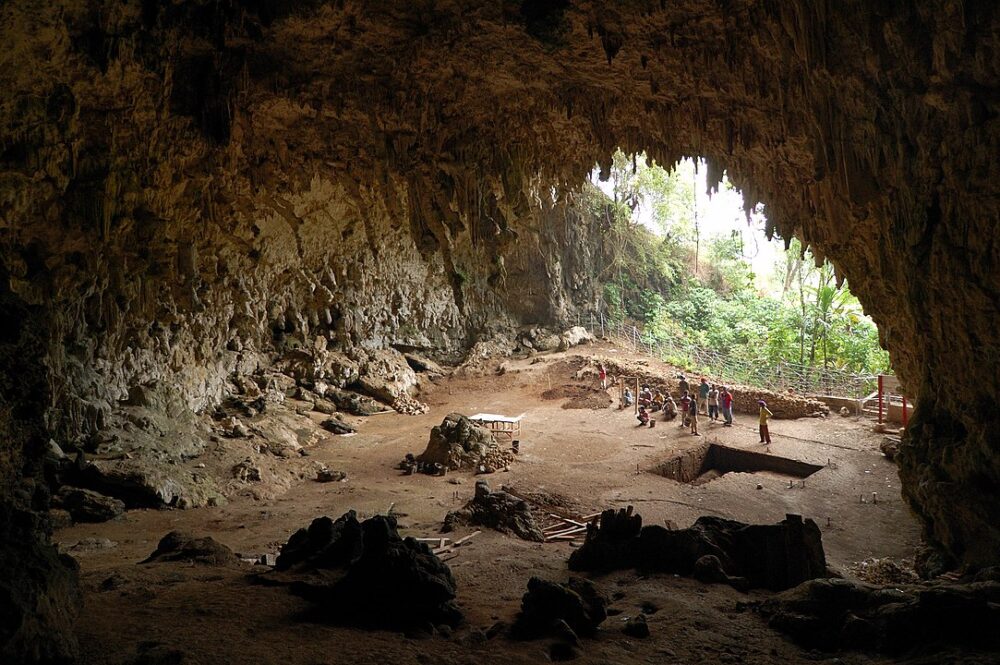
Homo floresiensis inhabited the Indonesian island of Flores until roughly 50,000 years ago. Despite their small stature and brain size, they made stone tools and hunted local animals, showing clear signs of adaptability. Fossils found in Liang Bua cave revealed a population that survived in isolation for millennia.
This long-term survival suggests they were well adapted to their environment. Any explanation for their disappearance must account for why a species that endured for so long suddenly failed to persist.
2. The new study focused on ancient climate conditions.

Rather than searching for new bones, researchers turned to environmental evidence. The study analyzed lake sediments and geological records to reconstruct climate patterns on Flores during the period when Homo floresiensis disappeared.
These records allowed scientists to track rainfall, vegetation, and water availability over time. The data revealed major shifts that would have directly affected food sources, hunting grounds, and freshwater access critical to survival.
3. Drought appears to have intensified on Flores.

The researchers found evidence of prolonged drought conditions developing around the time the hobbits vanished. Reduced rainfall would have shrunk rivers and lakes, transforming lush landscapes into harsher environments.
Such changes would have made survival far more difficult, especially for a small, isolated population. Water scarcity can cascade into food shortages, reduced prey populations, and increased competition, all of which raise extinction risk.
4. Water sources were central to hobbit survival.

Homo floresiensis likely relied heavily on predictable water sources, both for drinking and for attracting prey animals. As drought intensified, these water hubs may have disappeared or shifted location.
Without stable access to water, hunting efficiency would have declined. The study suggests the hobbits may have been forced to range farther or abandon familiar territories, increasing stress on already vulnerable populations.
5. Environmental stress may explain their disappearance without violence.

Earlier theories suggested Homo floresiensis may have been wiped out by volcanic eruptions or competition with modern humans. The new research offers a less dramatic but more gradual explanation.
Environmental stress does not require sudden catastrophe. Long-term climate deterioration can slowly erode a population’s ability to reproduce and survive, leading to eventual disappearance without a single defining event.
6. The hobbits may have followed water rather than vanished instantly.

One possibility raised by the study is that Homo floresiensis did not immediately die out, but instead moved as conditions worsened. As water sources shifted, the population may have followed them into new areas.
However, moving into unfamiliar terrain carries risks. New predators, limited shelter, and competition could have further reduced survival odds, especially for a small, isolated group.
7. Their isolation made them especially vulnerable to climate change.
Flores is an island, and island populations often face higher extinction risk. Limited space and resources mean fewer options when conditions change rapidly.
The hobbits had no neighboring populations to reinforce their numbers. Once environmental conditions crossed a critical threshold, recovery may have been impossible, even if small groups survived for a time.
8. The study does not rule out other contributing factors.

Researchers are careful to note that climate alone may not explain everything. Volcanic activity, ecosystem shifts, and interactions with modern humans could still have played supporting roles.
What the study does show is that environmental change was significant enough to place extreme pressure on the population. Climate stress may have set the stage for extinction, with other factors compounding the problem.
9. Modern humans arrived around the same period.

Homo sapiens reached the region roughly around the time Homo floresiensis disappeared. While direct conflict is unproven, the overlap raises important questions.
Even indirect competition for food or territory could have mattered. In a drought-stricken environment, the arrival of a more adaptable species may have further strained limited resources.
10. The findings challenge simple extinction narratives.

The disappearance of Homo floresiensis is often portrayed as a mystery with a single cause. This study highlights how extinction is usually more complex, involving multiple interacting pressures.
Rather than a sudden end, the hobbits’ story may reflect a slow unraveling driven by environmental instability, isolation, and limited adaptability to rapid change.
11. Climate played a powerful role in human evolution.

The study adds to growing evidence that climate shifts have repeatedly shaped human history. Environmental change influenced where early humans lived, how they moved, and which populations survived.
Homo floresiensis may be another example of how even well-adapted humans can be overwhelmed when ecosystems change faster than they can respond.
12. The research reshapes how scientists think about the hobbits’ fate.

Instead of asking only how Homo floresiensis disappeared, scientists are now asking how long they struggled before the end. The new climate evidence reframes their story as one of resilience followed by environmental defeat.
This perspective humanizes the hobbits’ fate and underscores a broader lesson: survival often depends less on strength or intelligence than on stable environments that allow life to endure.