
New calculations show the Mars time gap in microseconds and why it matters for future missions.

If you’ve ever joked that you’d like to “age better” on Mars, physics has a weird little twist for you: time really does move faster there. Not in a movie way, and not enough for a human to notice, but enough for spacecraft and future astronauts to care.
In December 2025, research by two physicists at the National Institute of Standards and Technology (NIST) calculated the time difference between Mars and Earth with new precision. Their work shows a clock on Mars would tick, on average, 477 microseconds faster per Earth day than a matching clock here.
That number also shifts over the Martian year because Mars travels in a more stretched-out orbit and feels changing gravitational influences. It’s a tiny effect that becomes a big deal when you’re trying to land safely, navigate accurately, and keep a growing network of Mars missions synchronized with Earth.
Click through to see how microseconds can create big consequences.
A Tiny Time Difference With Big Consequences

The headline sounds small: microseconds. But space exploration runs on exact timing, and “tiny” doesn’t stay tiny for long. The NIST team’s calculations put a real number on how Mars time drifts ahead of Earth time. That sets the stage for building reliable systems that can operate on Mars without constant confusion back home.
Follow us and access great exclusive content every day
Why Time Doesn’t Tick the Same Everywhere
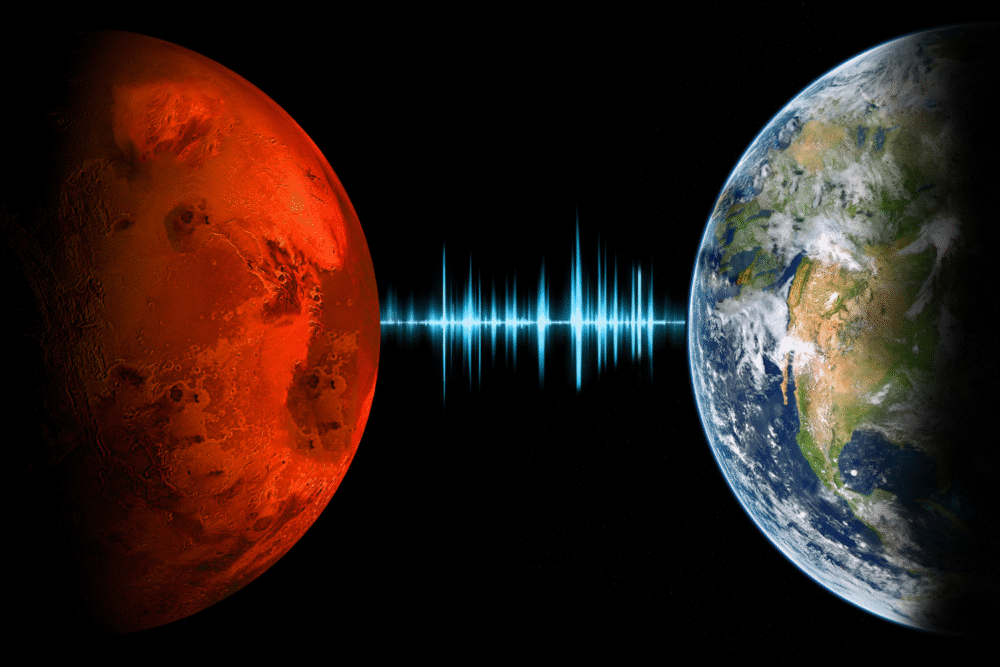
Einstein’s relativity says time depends on gravity and motion. Stronger gravity slows clocks slightly, and higher speeds change ticking rates too. Earth and Mars live in different gravitational environments and move differently through space, so their clocks can’t stay perfectly matched. The surprise isn’t that time differs—it’s that we now have a usable, mission-ready measurement.
Mars Has Weaker Gravity, So Its Clocks Run Faster

Mars is smaller than Earth, which means weaker surface gravity. In relativity terms, that lets time tick a bit faster on the Martian surface than it does here. You won’t feel it while sipping coffee, but instruments will. Think of it like two phones that keep time almost perfectly—until the small drift becomes a problem.
Follow us and access great exclusive content every day
The Number Scientists Landed On: 477 Microseconds Per Day
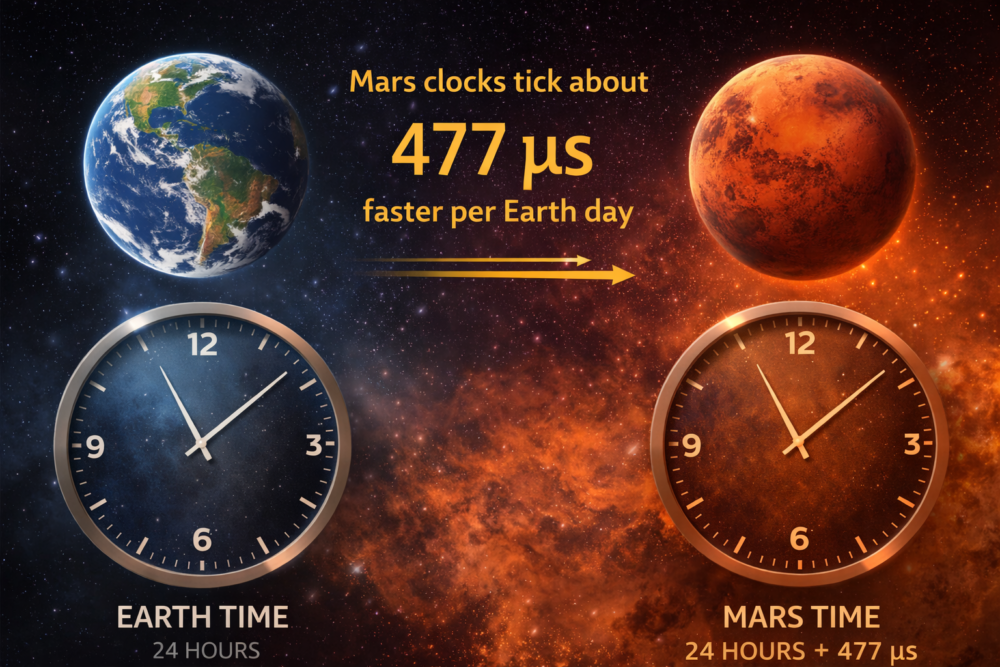
NIST’s estimate says Mars clocks tick about 477 microseconds faster per Earth day on average. That’s less than a thousandth of a second, but it’s consistent enough to matter. The key takeaway is practical: if you’re building systems that depend on timing, you have to bake that offset into your design.
It’s Not Constant Because Mars Doesn’t Travel in a Perfect Circle

Mars follows a more eccentric orbit than Earth, meaning its distance from the Sun changes more over its year. That changes the gravitational environment and the planet’s speed along its orbit. The result is the time difference isn’t a flat number every day. It naturally rises and falls as Mars moves through its seasonal loop.
Follow us and access great exclusive content every day
Why Microseconds Start to Matter Once You’re Living There

Here’s where this stops being a curiosity and starts becoming a real-world issue. Space navigation depends heavily on timing: when a signal is sent, when it’s received, and how that delay translates into distance and position. If clocks drift even slightly out of sync, location estimates slowly slide off target.
On Earth, GPS systems already require constant relativity corrections. Without them, directions would become unreliable surprisingly fast. Mars is approaching a similar threshold as missions grow more complex. Now picture a future Mars base. Crewed habitats, supply landers, surface vehicles, drones, and scientific instruments all need to operate on a shared timeline.
If one system timestamps an event a fraction of a millisecond differently than another, data logs can misalign, automated systems can hesitate, and troubleshooting becomes far harder. The challenge is that Mars’ time difference isn’t fixed—it changes over the Martian year.
Follow us and access great exclusive content every day
Why Mars Missions Will Need a Better Shared Clock

Today, many Mars missions use “sol” time (a sol is one full Martian day, about 24 hours and 39 minutes) to schedule daily operations. That makes sense for surface work, because it matches Mars’ natural day-night cycle. But sols only describe how long a day lasts, not how fast time itself ticks.
As missions multiply, relying on sols alone isn’t enough. A shared Mars time standard also needs to account for the subtle way clocks on Mars run faster than clocks on Earth, so systems stay synchronized over long missions.
How This Helps Build a Mars Version of GPS

A navigation network around Mars would need extremely precise time to triangulate positions, just like GPS does on Earth. The NIST calculations are a building block for that future. Without accounting for Mars’ time rate and its year-to-year variation, a Mars navigation system would gradually lose accuracy—exactly the opposite of what astronauts and robots need.
Follow us and access great exclusive content every day
What This Could Mean for Astronaut Routines

Humans won’t sense microseconds, but their systems will run on clocks: life support, power management, medical monitoring, communications, and vehicles. If you’ve ever dealt with devices that won’t sync, scale that problem up to a planet. A reliable Mars time standard reduces small mismatches that can turn into operational headaches.
The “So What” for Earth: Relativity Is Now a Daily Tool
This research is a reminder that relativity isn’t just a textbook idea. It’s an engineering requirement whenever we leave Earth. The same physics that keeps GPS working is now shaping how we’ll communicate, navigate, and coordinate on Mars. The next era of exploration depends on getting the small stuff right—especially time.