
New evidence suggests early humans’ tolerance to lead may have given them an evolutionary advantage.

A new study reveals that early humans may have survived toxic lead exposure better than Neanderthals—an unexpected twist in our shared evolutionary story. By analyzing ancient teeth and bones, researchers found traces of lead suggesting both species lived near contaminated sites. But modern humans seemed to handle the exposure with fewer long-term effects. Scientists think this resilience could have provided a hidden survival edge, helping our ancestors adapt to harsh environments while Neanderthals gradually disappeared.
1. Researchers Studied Lead in Ancient Teeth
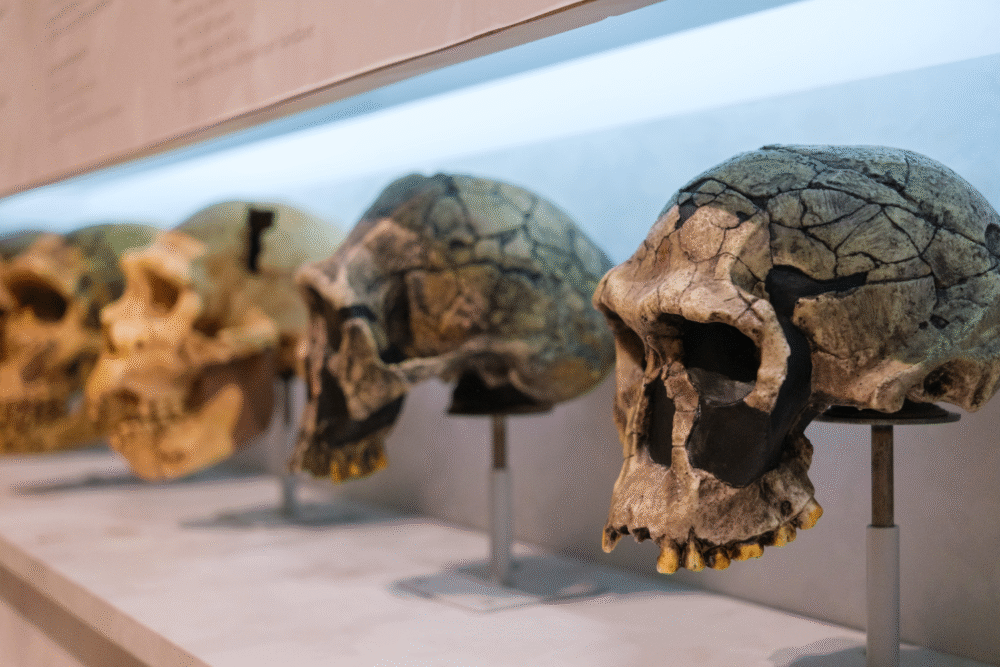
Scientists from the University of Chicago and other institutions examined fossilized teeth from early Homo sapiens and Neanderthals found in Europe and the Middle East. Using advanced chemical analysis, they measured lead levels locked inside the enamel—one of the most durable biological materials.
These trace elements record environmental exposures during childhood. The results showed that both Neanderthals and early modern humans were regularly exposed to lead, likely through contaminated soil, water, or food near mineral-rich regions or ancient cave dwellings.
2. Lead Exposure Was Surprisingly Common in Prehistoric Life

Lead is naturally found in the Earth’s crust, and ancient humans often encountered it without realizing the danger. When early people used mineral pigments or drank from lead-contaminated water sources, they could absorb the metal into their bodies.
Studies of prehistoric settlements show that caves and rock shelters often contained lead-bearing dust or pigments like galena. Over time, repeated low-level exposure may have been unavoidable, especially for groups who lived near metal-rich landscapes such as southern Europe.
3. Neanderthals and Modern Humans Faced Similar Environments

The findings indicate that Neanderthals and early modern humans often occupied overlapping territories, hunting and gathering in the same valleys, forests, and caves. That means both groups were exposed to similar sources of lead.
Despite this, the fossil record suggests that Neanderthals suffered more health stresses overall, including signs of malnutrition and physical trauma. The new study adds another layer—implying that their physiology may have been less able to manage the harmful effects of toxins like lead.
4. Lead Leaves Lasting Traces in Teeth and Bones

Because tooth enamel forms in childhood and never regenerates, it preserves a permanent record of environmental conditions. Researchers used laser ablation and mass spectrometry to map tiny bands of lead within each tooth, much like reading tree rings.
These patterns revealed episodes of exposure during specific seasons or life stages. In some Neanderthal samples, high concentrations corresponded with signs of illness or developmental stress, suggesting that toxic metals might have compounded other survival challenges.
5. Modern Humans Showed More Resilience to Lead

One of the study’s most intriguing discoveries is that early Homo sapiens appear to have tolerated lead exposure better than Neanderthals. Their dental and skeletal remains showed fewer signs of developmental disruption, even when lead levels were comparable.
Scientists don’t yet know why. It’s possible that genetic differences in metabolism or detoxification pathways gave modern humans a slight advantage, allowing them to process or isolate heavy metals more effectively. Over generations, that resilience could have improved survival and reproduction rates.
6. Lead Exposure May Have Driven Biological Adaptation

Repeated exposure to environmental toxins can exert evolutionary pressure. Researchers hypothesize that humans who could better tolerate heavy metals may have been more likely to survive in diverse and resource-scarce regions.
This doesn’t mean lead was beneficial—it remained harmful—but small genetic variations that lessened its impact could have become more common over time. Such resilience might have helped early Homo sapiens expand into new territories that were challenging for Neanderthals to inhabit long-term.
7. The Study Adds a New Factor to Human Evolution

Until now, explanations for why modern humans replaced Neanderthals have focused on climate, diet, and social behavior. The new findings introduce a biological element: differential resistance to environmental toxins.
While not the sole reason for Neanderthal extinction, lead tolerance may have contributed to a cumulative advantage. Combined with improved cooperation, toolmaking, and adaptability, this hidden trait could have helped modern humans thrive as Neanderthals struggled to recover from repeated stress.
8. Lead Poisoning Still Poses a Threat Today

Although modern exposure comes mostly from industrial sources, lead poisoning continues to affect millions of people worldwide. Even low levels can impair brain development in children and damage the nervous system, kidneys, and cardiovascular health.
The ancient findings remind scientists how long humans have lived with environmental toxins—and how biological resilience doesn’t mean immunity. Modern health researchers stress that even trace exposure should be minimized through safer infrastructure, clean water, and global public health efforts.
9. Ancient DNA May Hold Clues to Resistance

Future studies may reveal whether specific genes related to heavy metal detoxification differ between Neanderthals and Homo sapiens. Genes like ALAD and VDR, which influence how the body processes lead and vitamin D, could play a role.
Advances in ancient DNA sequencing could test these hypotheses directly. If certain alleles linked to toxin resistance appear more often in modern humans, it would strengthen the case that natural selection favored resilience to environmental contaminants early in our evolution.
10. Evolution Was Shaped by More Than Intelligence Alone

The discovery challenges the long-held idea that intelligence and social complexity were the only keys to humanity’s survival. Biology itself—right down to how our cells handle toxins—may have given modern humans a crucial edge.
By examining microscopic traces of lead in ancient remains, researchers are piecing together how adaptation operated on multiple levels. The story of human evolution may therefore include not only creativity and cooperation, but also a quiet, chemical endurance that helped our ancestors outlast their closest relatives.