
Decades of study reveal ancient Maya astronomers forecast solar eclipses centuries before modern tools existed.

Long before telescopes or modern astronomy, the ancient Maya were tracking the skies with remarkable precision. Recent research into centuries-old Maya codices reveals that their astronomers could accurately predict solar eclipses hundreds of years in advance. Using careful observations of the Sun, Moon, and Venus, they created complex mathematical calendars that rivaled modern scientific models. The findings shed new light on the sophistication of Maya science and their deep understanding of cosmic cycles that shaped both ritual and daily life.
1. The Maya Were More Than Builders—They Were Skilled Astronomers

While the Maya are best known for their towering pyramids and intricate art, they were also exceptional scientists who studied the heavens with precision. Their astronomers tracked celestial bodies like the Sun, Moon, and Venus for centuries, documenting their movements on stone monuments and codices.
This deep observation allowed them to recognize recurring patterns that would eventually form the basis for predicting astronomical events. Their achievements in mathematics and astronomy were unmatched in the ancient world, rivaling calculations made thousands of years later.
2. The Dresden Codex Holds the Key

One of the most remarkable surviving Maya texts, the Dresden Codex, contains detailed eclipse tables that astonished researchers. These calculations, written around the 11th or 12th century, accurately predict solar and lunar eclipses that occurred both before and after its creation.
The codex shows that the Maya had developed algorithms to predict when and where these celestial events would occur. Scholars analyzing the text found it aligned closely with modern astronomical data, demonstrating the Maya’s advanced mathematical precision.
3. Eclipses Were Central to Maya Religion and Power

To the Maya, eclipses weren’t just natural phenomena—they were sacred events tied to divine cycles and royal authority. Priests interpreted eclipses as cosmic messages, often signaling times of change, renewal, or potential danger.
Kings used these predictions to legitimize their rule, aligning rituals and public ceremonies with astronomical events. This blending of science and spirituality strengthened the ruler’s connection to the gods, reinforcing the Maya belief that their leaders mediated between the heavens and Earth.
4. Their Eclipse Predictions Spanned Centuries

Unlike many ancient civilizations that recorded events year by year, the Maya thought in terms of vast cosmic cycles. Their eclipse tables could forecast celestial events centuries ahead, far beyond the lifetime of any single ruler or priest.
By calculating the intervals between past eclipses and future ones, they created predictive models that anticipated the 177-day and 148-day cycles we still use today. These calculations proved so consistent that some align perfectly with modern NASA eclipse predictions.
5. Mathematics Was the Foundation of Maya Astronomy

The Maya used a vigesimal, or base-20, numbering system that included a concept of zero—one of the earliest known uses of it in human history. This innovation allowed for precise long-term calculations that made their eclipse forecasts possible.
With this mathematical foundation, they could chart planetary motion, create seasonal calendars, and synchronize their ceremonial rituals with astronomical phenomena. Their combination of geometry, arithmetic, and observation demonstrates a scientific sophistication often underestimated in ancient societies.
6. They Used Venus as a Celestial Clock

Venus held special importance in Maya astronomy, symbolizing war, renewal, and cosmic balance. Maya astronomers discovered that Venus’s cycles often coincided with eclipse intervals, allowing them to use the planet as a guide for refining predictions.
By tracking Venus’s appearance and disappearance from the morning and evening sky, they could anticipate when solar eclipses were most likely to occur. The planet’s rhythmic behavior gave their calendar extraordinary predictive power—blending observation, mythology, and mathematics.
7. Observatories Played a Critical Role
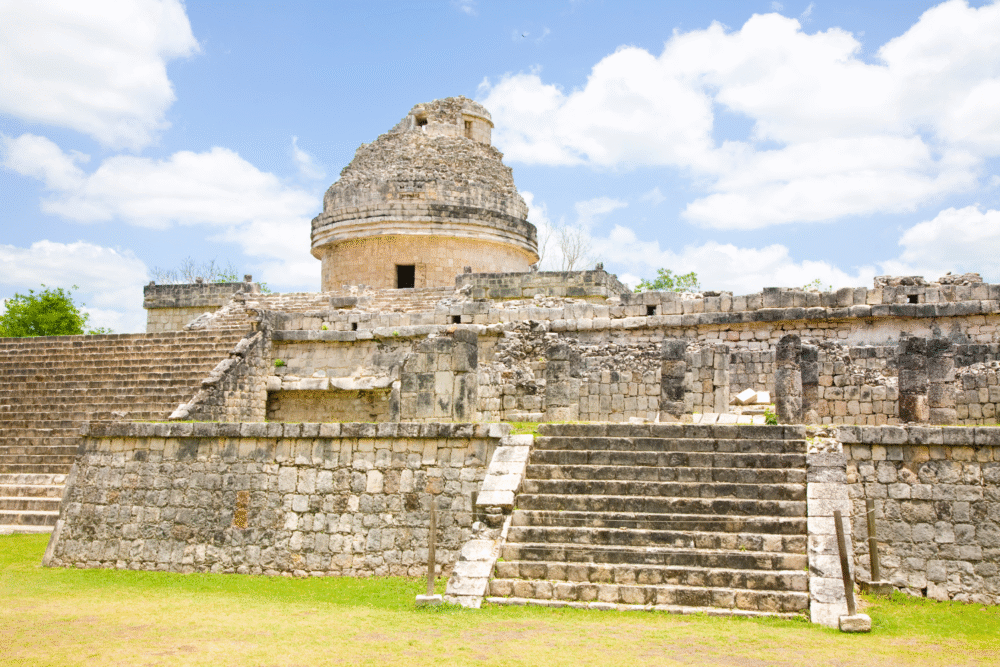
Across the Maya world, from Chichén Itzá to Uxmal, ancient observatories still stand as silent witnesses to their astronomical skill. Buildings such as El Caracol were precisely aligned with solar and planetary positions, allowing priests to monitor celestial changes.
These observatories were more than temples—they were early scientific institutions. By combining systematic sky-watching with mathematical record-keeping, the Maya created a continuous database of celestial motion that enabled their eclipse predictions to remain accurate over generations.
8. The Predictions Were Used to Shape Daily Life
Eclipse forecasting had practical value beyond ritual significance. It helped the Maya plan agricultural cycles, festivals, and trade. Farmers relied on calendar systems derived from astronomical observations to time planting and harvest seasons.
Because the Maya saw cosmic balance as essential for human prosperity, understanding celestial rhythms meant understanding how to live in harmony with nature. Their astronomical knowledge connected everyday survival with spiritual and scientific insight in ways that few cultures have matched.
9. Modern Science Confirms Their Accuracy

When researchers compared Maya eclipse tables to modern astronomical models, they found only minor deviations—often less than a single day off across centuries. This precision is particularly impressive given that the Maya had no telescopes or mechanical instruments.
Instead, they relied on naked-eye observation, meticulous recordkeeping, and generational continuity. Their success highlights how human ingenuity and patience can rival even modern technology when guided by disciplined scientific method.
10. The Maya Legacy Still Shapes Our Understanding of Time

The Maya’s mastery of astronomy continues to influence how scientists interpret ancient cosmology and timekeeping. Their understanding of cyclical time—where history repeats in cosmic patterns—contrasts with the linear models used in the modern West.
By decoding the Maya eclipse tables, scientists gain more than historical data—they rediscover a worldview where science, spirituality, and nature are inseparable. The precision and wonder of Maya astronomy remind us that advanced knowledge can thrive in many forms, even without modern tools.