
Residues found on ancient arrow tips show poison use goes back much further than thought.

Sixty thousand years ago, hunting wasn’t just about strength or sharp stone—it was about chemistry. Scientists analyzing tiny residues on ancient stone points found something that changes the timeline of human ingenuity: evidence of poison use that far back in the past.
The artifacts come from Umhlatuzana Rock Shelter in South Africa, and the chemical traces point to plant-based toxins applied to arrow tips. The research was published in Science Advances in January 2026.
It suggests early humans weren’t only making projectiles; they were engineering slow-acting effects that helped them bring down larger animals and survive in tough conditions.
1. The Surprise Wasn’t the Arrowheads—It Was the Chemistry

The stone points themselves have been known for years, but microscopic residue analysis changed the story. Researchers examined quartz microliths from Umhlatuzana Rock Shelter and detected chemical traces consistent with toxic plant compounds on some of the tips.
That matters because poison doesn’t preserve easily, and many older claims were based on inference. Here, the evidence is direct: the toxins were actually on the hunting equipment, not just imagined as a possibility.
2. Why “Oldest Poison” Is the Real Headline

This discovery isn’t just about early archery. It’s about how far back humans were using poison as a survival tool—long before farming, metal, or written records. The arrows are simply where the poison happened to be preserved.
When you push confirmed poison use back to around 60,000 years ago, it reframes what “advanced” means. It suggests knowledge of toxic plants, preparation, and controlled application existed deep in the Stone Age.
3. Where the Evidence Comes From

The site is Umhlatuzana Rock Shelter in KwaZulu-Natal, South Africa, a place with layers of human occupation spanning tens of thousands of years. The stone points were recovered decades ago, but new methods allow scientists to test residues that were once invisible.
In the recent analysis, researchers tested a set of small quartz points and found that several retained traces of toxic substances. That’s the key: not a guess, but detectable chemical signatures tied to the tool surfaces.
4. Poison Solves a Practical Hunting Problem

Stone Age hunters faced a hard reality: small projectiles don’t always drop big animals quickly. Poison changes the equation. A small wound can become lethal over time, making it possible to hunt larger or faster prey without needing a perfect, immediate takedown.
This also reduces risk to hunters. Instead of close-range confrontation, poison allows distance, patience, and tracking—turning hunting into a strategy game where time becomes part of the weapon.
5. The Poison Was Likely Slow-Acting

The evidence points toward toxins that wouldn’t necessarily kill instantly. That fits how many traditional hunting poisons work: they weaken an animal gradually, making it easier to follow, exhaust, and finish safely.
A slow-acting poison also demands discipline. Hunters would need to recognize the effects, track for longer distances, and avoid giving up too early. In other words, the technology isn’t just poison—it’s planning built into the hunt.
6. Why This Requires Advanced Thinking

Using poison on arrows isn’t a single clever trick. It implies a chain of knowledge: which plants are dangerous, how to extract or concentrate compounds, how to apply them so they stay effective, and how to store or transport them safely.
It also implies cause-and-effect reasoning over time. If the prey doesn’t fall immediately, you still trust the method, keep tracking, and anticipate what will happen hours later. That kind of delayed payoff is a real cognitive milestone.
7. The Tools Hint at Bow-and-Arrow Use
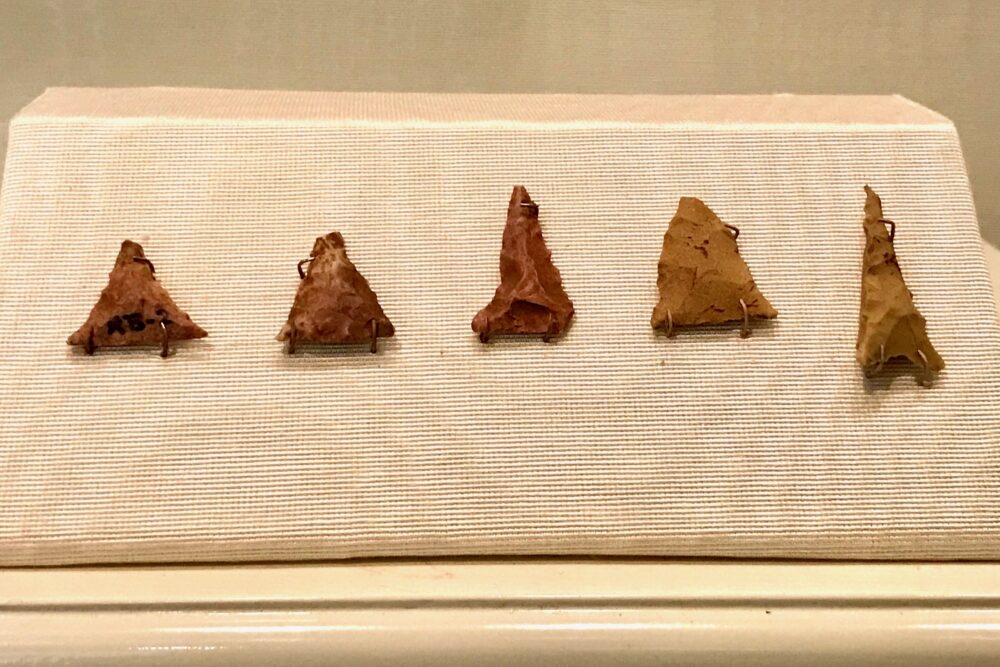
These tiny stone microliths are consistent with technology used as arrow insets or tips, not just hand-held knives. That’s important because it supports the idea that bow-and-arrow systems—already suspected this early—were paired with chemical enhancement.
Even if you imagine early projectiles as “simple,” poison makes them sophisticated. The combination suggests people weren’t merely throwing sharp objects; they were optimizing a full hunting system with multiple components working together.
8. Why Direct Proof Is So Rare

Archaeologists have long suspected early poison use because of tool shapes and ethnographic parallels, but proving it is notoriously difficult. Organic toxins break down, wash away, or get contaminated over millennia.
That’s what makes chemical residue work so powerful and so cautious. Researchers have to rule out modern contamination and ensure the detected compounds match ancient residues on the tool surfaces. When they do, the claim becomes much stronger than “it seems likely.”
9. How This Changes the Timeline of Human Know-How

This finding pushes chemically supported poison use far deeper into the past than many people assume. It suggests early humans weren’t only innovating in stone— they were innovating in invisible technologies like plant chemistry, preparation, and application.
That’s a different kind of intelligence than carving a tool. It’s knowledge of ecosystems, experimentation, and transmitted expertise—skills that depend on learning, memory, and teaching across generations.
10. A Hidden Link Between Ancient and Historic Practices

One striking implication is continuity: hunting poisons made from plants are documented in southern Africa in much more recent times, and this discovery suggests the roots of that knowledge may be extremely old.
Researchers can’t claim a direct, unbroken line from one group to another across 60,000 years. But the concept—using local toxic plants to improve hunting success—appears repeatedly, which hints that this was an enduring solution humans returned to again and again.
11. The Bigger Story Is Human Survival, Not Weapons

It’s tempting to focus on the drama of “poison arrows,” but the deeper takeaway is about survival in difficult landscapes. Poison represents efficiency: more food with less risk, less energy, and more certainty over time.
And it highlights something we sometimes forget about early humans. They weren’t waiting for civilization to make them clever. They were already experimenting, refining, and using the natural world like a toolkit—down to the molecules.