
Researchers observed metal atoms flowing like a liquid while staying locked in a solid structure.

For centuries, science classes have taught that matter comes in a few familiar forms: solid, liquid, gas, and plasma. Each behaves in predictable ways, with atoms either locked in place or free to flow. But recent laboratory work has complicated that tidy picture.
Researchers studying metals at the atomic level observed something that doesn’t fit cleanly into those categories. Under highly controlled conditions, atoms behaved like a liquid while remaining arranged like a solid.
This matters now because it pushes back on one of the most basic frameworks used to understand the physical world. States of matter aren’t just textbook concepts. They underpin how materials are designed, how electronics work, and how energy moves through systems.
Click through to discover how matter doesn’t always behave the way we assume.
1. Why states of matter usually feel so straightforward

Most of us learn early that solids keep their shape, liquids flow, and gases spread out. These rules hold true in everyday life, from ice cubes to water to air. They’re based on how tightly atoms are arranged and how freely they can move.
Because these categories work so well in daily experience, it’s easy to assume they cover every possibility. In reality, they are simplified models. At extreme scales, especially at the level of individual atoms, matter can behave in ways that don’t fit neatly into familiar boxes.
2. The experiment focused on atoms, not bulk material

The new observations didn’t come from melting metal or changing its temperature in ordinary ways. Instead, researchers studied metal atoms confined to an incredibly small space. At this scale, the behavior of individual atoms becomes more important than the behavior of the material as a whole.
Using advanced imaging and precise control, scientists were able to watch how these atoms moved in real time. What they saw challenged long-standing assumptions about how atomic structures should behave.
3. The atoms stayed ordered but didn’t stay still

In a typical solid, atoms vibrate but remain fixed in a rigid structure. In a liquid, atoms move freely past one another, breaking any long-term order. In this experiment, something unexpected happened.
The atoms maintained an orderly, solid-like arrangement. At the same time, they flowed and shifted positions like a liquid. This combination of structure and motion had never been directly observed in this way before.
4. Why this isn’t just a liquid trapped in place

At first glance, it might sound like a liquid simply confined by walls. But that’s not what was happening. The atomic arrangement remained stable, more like a crystal than a puddle. The movement occurred within that structure, not around it.
This distinction matters because it shows the behavior wasn’t caused by external pressure alone. It emerged from how the atoms interacted with each other under confinement.
5. How confinement creates entirely new behavior

The key to this discovery is extreme confinement at the atomic scale. When atoms are squeezed into very small spaces, their usual behavior changes. Forces that are normally weak become dominant, altering how atoms bond, repel, and move.
Here, confinement kept the atoms from fully becoming a liquid, while still allowing them to move together. The result was a hybrid state with traits of both solids and liquids, which helps explain why this behavior only appears under very specific conditions and not in everyday materials.
6. Why this counts as a new state of matter
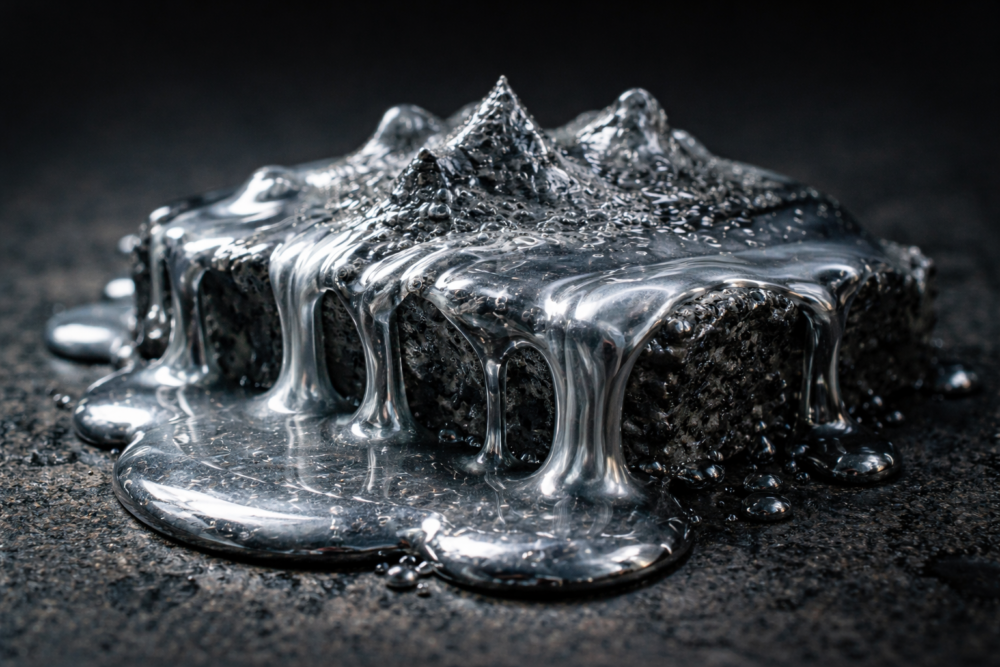
Scientists are cautious about naming new states of matter. The term is only used when behavior can’t be explained by existing categories. Here, neither solid-state physics nor liquid dynamics fully describe what was observed.
Because the atoms displayed both long-range order and liquid-like motion, researchers consider this a distinct phase rather than a variation of an existing one. It expands the map of how matter can behave.
7. What this reveals about atomic forces

At the atomic level, tiny forces govern everything. Changes in spacing or movement can dramatically alter behavior. This experiment highlights how sensitive matter is to its environment, especially when confined.
It also shows that atomic interactions can produce stable, unexpected outcomes. That challenges the assumption that matter always settles into the simplest possible state.
8. Why this discovery matters beyond the lab

While this state of matter exists under controlled conditions, the principles behind it have broader implications. Understanding how atoms behave under confinement could influence how materials are engineered at the nanoscale.
That could affect fields like electronics, energy storage, and advanced manufacturing, where atomic precision already plays a critical role.
9. It reshapes how scientists think about materials
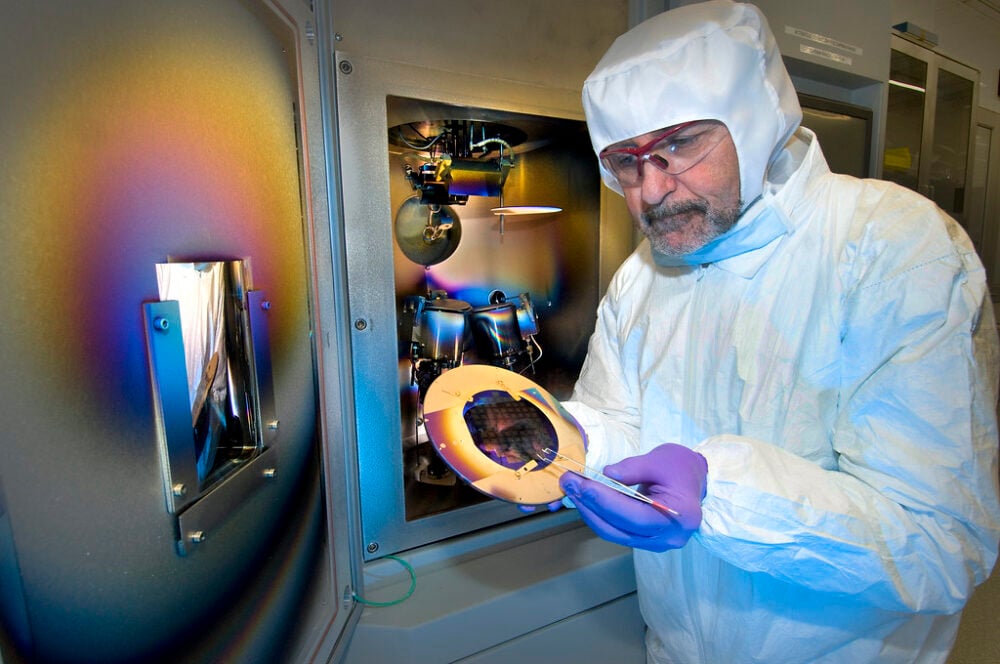
For decades, materials science has relied on well-defined phases to predict behavior. Discoveries like this suggest those boundaries are more flexible than once thought.
By studying these hybrid states, researchers can better understand transitions between phases and uncover behaviors that were previously invisible.
10. Why most people have never heard of this before

These experiments require highly specialized tools and conditions, which is why the discovery feels sudden. The behavior wasn’t new to nature, but it was new to observation.
Only recently have instruments become precise enough to watch atoms move this way, opening the door to findings that challenge long-held assumptions.
11. A reminder that the physical world is still full of surprises

Even in fields as established as physics, fundamental discoveries still happen. This hybrid state of matter shows that the rules we rely on are often approximations, not absolutes.
As scientists continue probing matter at smaller scales, more unexpected behaviors may emerge. For readers, it’s a reminder that even the most basic concepts can evolve when we look closely enough.