
Researchers found a loophole in quantum laws — and it could power the navigation of real interstellar missions.
Imagine boarding a spacecraft bound for another star system — and the tricky part, long assumed impossible, is navigating accurately across light-years of empty space. Scientists have now identified a new quantum loophole that allows atomic clocks to be far more stable and precise than ever before. According to TSA-style timekeeping in GPS satellites, this breakthrough in atomic timing could one day make deep-space route-planning viable. While we’re not booking starships yet, the discovery marks a major step toward turning interstellar travel from sci-fi dream into long-term possibility.
1. A Quantum “Loophole” That Changes the Rules

Physicists have uncovered an unexpected gap in how quantum systems behave — a loophole that lets particles remain synchronized longer than previously thought possible. This discovery reshapes one of physics’ most stubborn limits on measurement and precision.
In simple terms, scientists found a way for atoms to “talk” to each other more coherently, keeping time with incredible accuracy. That kind of stability could transform technologies that rely on precise timing — including deep-space navigation and communication between far-flung spacecraft.
2. The Breakthrough Happened Inside Atomic Clocks

The key to this finding lies in atomic clocks, which measure time based on the vibrations of atoms like strontium or ytterbium. These clocks are already the most accurate instruments ever made, but they still drift slightly over long periods.
Researchers noticed a subtle quantum effect that could reduce that drift dramatically. By exploiting this loophole, they were able to stabilize the energy states of atoms in ways previously thought impossible — potentially redefining what “perfect time” means in science.
3. Why Timekeeping Matters for Space Travel

In deep space, even a one-second error can send a spacecraft thousands of miles off course. Current navigation depends heavily on signals from Earth, which become unreliable the farther you go.
A ship equipped with a near-perfect atomic clock could calculate its own position with extreme accuracy — a critical step toward autonomous interstellar travel. The quantum loophole discovery could make that level of precision realistic within the next few decades.
4. The Experiment That Proved It Works

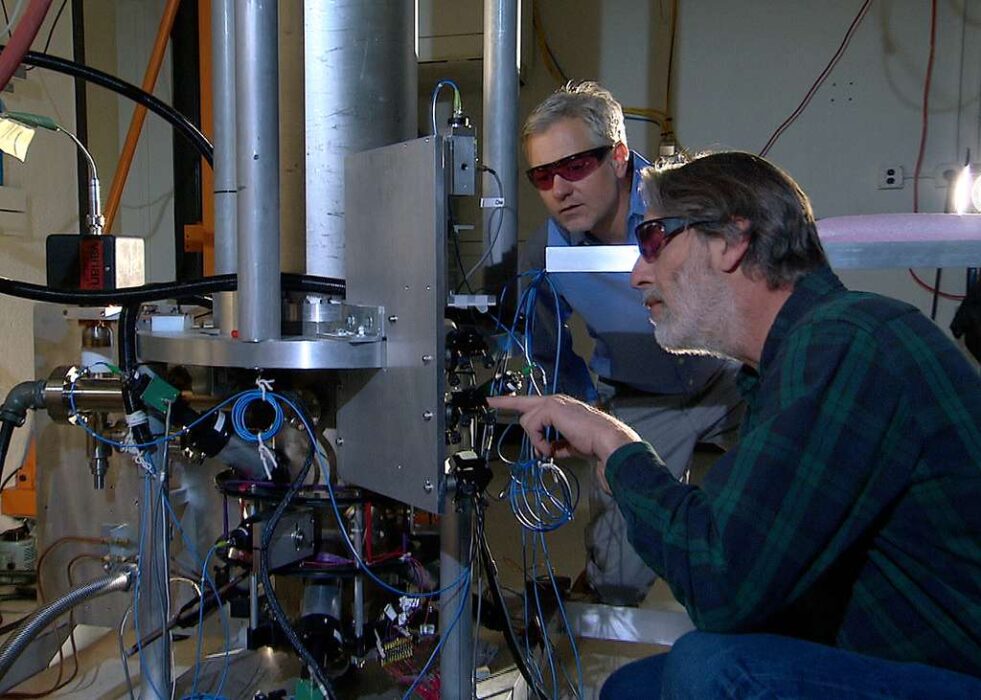
Scientists from JILA, a joint institute of the University of Colorado and NIST, conducted a series of tests using ultra-cold atoms suspended in laser light. The atoms exhibited interactions that broke known limits of synchronization.
Instead of losing coherence, the particles maintained it far longer than predicted. The finding didn’t violate quantum mechanics — it simply revealed an overlooked exception. The data matched perfectly with mathematical models suggesting that “quantum entanglement” could stabilize time itself.
5. Quantum Entanglement at the Core of the Discovery

Entanglement allows particles to share information instantly across any distance, a phenomenon Einstein once called “spooky action at a distance.” The new research shows that this same principle can help atoms resist environmental noise that usually throws off timing.
By linking atomic states through entanglement, researchers achieved an unprecedented balance. In practice, that means an entire network of atomic clocks could stay locked together in perfect harmony — an essential feature for exploring vast, uncharted regions of space.
6. Why Scientists Call It a “Loophole”

In physics, a loophole doesn’t mean an error — it’s a gap in what theory predicts versus what reality shows. For decades, researchers assumed there was an upper limit to how stable atomic systems could be. This discovery proves that limit can be exceeded.
That small deviation opens up massive possibilities. It’s like finding an unmarked path through the laws of physics — one that doesn’t break them but shows they’re more flexible than scientists thought.
7. The Technology Behind the Discovery
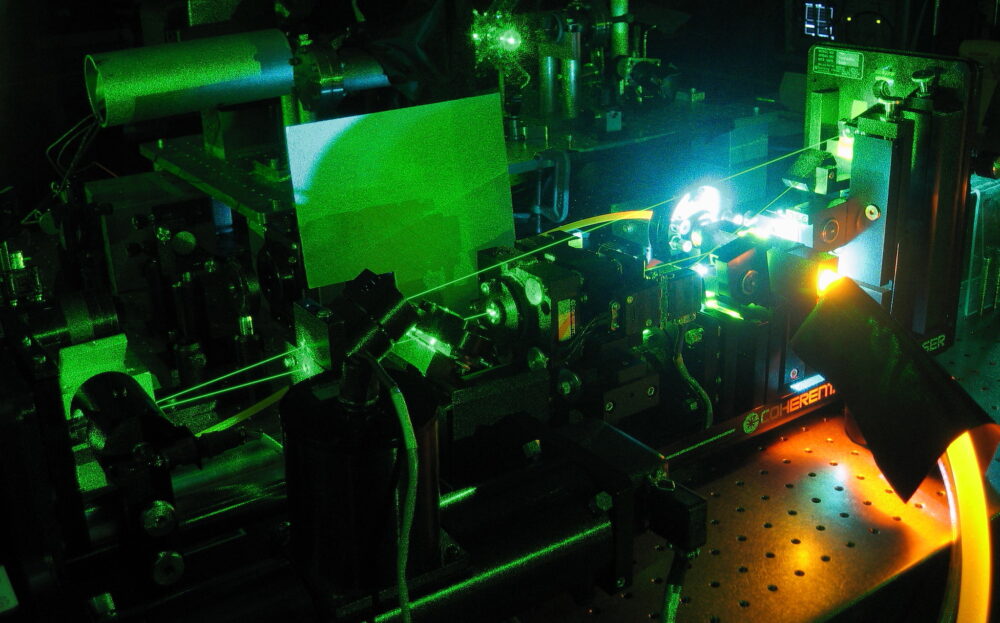
These new experiments rely on optical lattice clocks — devices that trap thousands of atoms in a grid of laser light. Each atom acts like a tiny pendulum, ticking with unbelievable consistency.
By manipulating the way these atoms interact, researchers found a configuration that effectively shields them from quantum noise. The result is a clock so precise that it would lose less than a second over the entire age of the universe — the kind of reliability future spacecraft would need.
8. What It Could Mean for Interstellar Navigation

Interstellar travel isn’t just about propulsion; it’s about knowing exactly where you are in the void. Today’s spacecraft use radio signals from Earth for guidance, but those signals weaken over distance.
With ultra-stable quantum clocks on board, a ship could calculate its own trajectory using pulsar timing or gravitational landmarks. That would give future explorers true independence from Earth-based control — a necessary step for missions beyond our solar system.
9. Quantum Physics Meets Space Exploration
NASA and the European Space Agency are already investing in space-ready atomic clocks for deep-space missions. The new quantum loophole could dramatically improve those designs, making them smaller, more stable, and more energy-efficient.
If perfected, this technology could guide probes through the galaxy without waiting for instructions from mission control — a fundamental shift in how we think about navigation and communication in the cosmos.
10. Skeptics Say It’s Still Early Days

Not everyone is convinced this discovery will revolutionize space travel soon. Some physicists caution that laboratory conditions are far different from deep-space environments.
Replicating this level of quantum stability outside controlled experiments will be a major challenge. But even skeptics agree that the loophole opens new doors — and may point to principles of quantum behavior we’ve only begun to understand.
11. A Step Toward Faster-Than-Light Theory?

While this research doesn’t make faster-than-light travel possible, it could inform how scientists approach spacetime navigation in the future. Accurate clocks are essential for testing theories like wormholes, time dilation, and quantum tunneling.
The more precisely we can measure time, the closer we get to seeing if those theoretical shortcuts through space could ever exist in reality. For now, this is a step toward making science fiction sound slightly less fictional.
12. The Future of Quantum-Powered Exploration

Quantum mechanics once seemed like a mysterious corner of physics. Now it may hold the key to unlocking the universe. The same principles that power your smartphone’s microchips could one day steer spacecraft between the stars.
This discovery isn’t just about timekeeping — it’s about redefining what’s possible when precision meets imagination. If quantum physics can give us clocks that never falter, it might also give humanity the confidence to push far beyond the solar system.