
Modern life keeps hitting primal panic buttons that were meant for predators, not notifications.

Your nervous system evolved in a world of immediate danger and slow-paced change. It was built to spot a rustling bush, not decipher a vague text. It learned to track the mood of a tight-knit tribe, not 300 comment threads. It wasn’t designed to process breaking news from 12 time zones or to flinch every time your lock screen lights up. And yet, that’s exactly what it’s being asked to do—over and over again, all day long.
The result isn’t always a breakdown. It’s often something quieter: a chronic sense of unease, a short fuse, a mind that won’t settle even when things are fine. These aren’t signs of personal weakness. They’re signs your oldest survival systems are misfiring in a world they weren’t made for. The threats feel new, but the reactions are ancient. And the mismatch is shaping how we live, how we relate, and how we make sense of danger in a world that rarely slows down.
1. Loud noises and sudden pings still trigger your fight-or-flight reflex.

Back when survival depended on hearing a twig snap in the woods, your brain evolved to treat sudden sounds as potential threats. That instinct hasn’t gone anywhere. So when your phone vibrates sharply or a car alarm goes off, your body responds first—before your brain even registers what’s happening. William J. Ray and colleagues explain in Physiological Psychology that startling sounds instantly trigger an autonomic stress response, including increased heart rate, muscle tension, and a rush of stress hormones.
The problem is, those noises aren’t followed by a lion. They’re followed by an email, a notification, or a glitchy video. But your body doesn’t know that. The response still activates, and over time, constant exposure to these “false alarms” trains your nervous system to stay on edge. It’s not irrational to feel rattled by modern noise. It’s deeply biological. Your ancestors survived by reacting fast. But in a world where alerts never stop, there’s no clear signal for when the danger ends.
2. Public opinion feels like a life-or-death threat.

In early human societies, social standing wasn’t a bonus—it was survival. Being liked, trusted, or included meant access to resources and protection. Being shunned or exiled could mean death. So your brain evolved to treat social judgment as seriously as physical harm. Naomi I. Eisenberger notes in Current Directions in Psychological Science that the brain processes social pain—like rejection or public criticism—in the same regions that handle physical pain, which is why it hits so hard. Modern life cranks that instinct into overdrive. You’re not just being evaluated by your tribe—you’re being watched by coworkers, classmates, acquaintances, and strangers on the internet.
A comment, a side-eye, a message left on read—it all registers as threat. Not because you’re overly sensitive, but because your brain was built to scan for social cues as a matter of survival. It still can’t tell the difference between being left out of a group chat and being cast out of the village.
3. Your brain can’t tell the difference between real danger and imagined scenarios.

Humans are great at anticipation. It’s what let us survive winters, avoid predators, and plan for the unknown. But that imagination came with a cost: Sally Winston and Martin Seif explain on the ADAA site that when you imagine future threats, your body often responds as if those events are already unfolding—triggering real anxiety from unreal scenarios.
In modern life, this means that thinking about confrontation, embarrassment, or failure can activate your stress response before anything’s even occurred. You feel panic in the grocery store while replaying a conversation that hasn’t happened. You spiral while lying in bed, sweating through imaginary future disasters. That reaction isn’t irrational—it’s a built-in alarm that was never meant to be triggered by thoughts alone. But in a world full of uncertainty, your brain often mistakes projection for proof.
4. Constant stimulation makes you feel hunted—even when you’re safe.
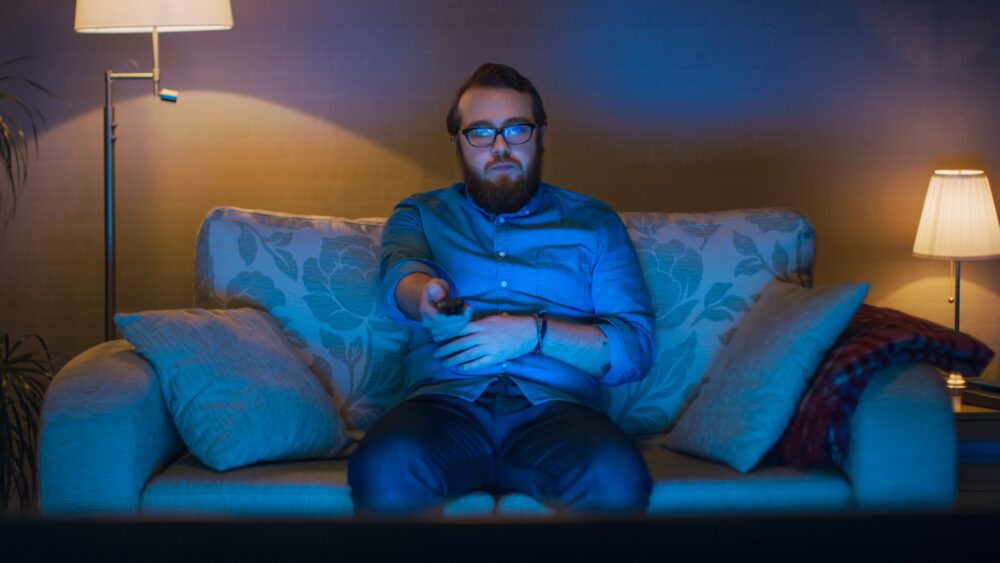
Your ancestors didn’t live in a world of back-to-back demands and 24/7 input. Their nervous systems had time to reset. Stillness was built into the day. But modern life rarely pauses. Messages, deadlines, headlines, feeds—it’s all layered noise, and your brain treats it like a moving target. Something’s always coming. Something’s always about to happen. There’s no clean break between safety and threat. This leads to a baseline feeling of being pursued. Not by a predator, but by responsibility.
Even rest gets interrupted by reminders. You’re never fully “off,” which means your brain doesn’t know when it can truly downshift. Over time, the background sense of danger becomes your new normal. Not because anything is chasing you—but because everything is.
5. You crave novelty like it’s food—and tech knows it.

In ancient environments, novelty signaled opportunity. A new fruit, a new path, a change in weather—it was worth paying attention to. Your brain evolved to reward novelty with dopamine. In the wild, that helped you adapt and survive. But today, novelty is everywhere. Every swipe brings something new. Every refresh, a new hit. And the system designed to help you notice rare changes is now being hijacked by constant ones.
Apps and platforms are built around this vulnerability. The “pull to refresh” isn’t just a gesture—it’s a behavioral loop. You’re not addicted to your phone because you’re weak. You’re responding exactly how a well-designed nervous system responds to the promise of something new. But when novelty never ends, your brain can’t settle. It’s always scanning, always chasing, always hungry.
6. Modern time pressure activates instincts meant for survival sprints.

Your ancestors experienced urgency in short bursts—escaping a predator, securing shelter, reacting to a storm. The stakes were immediate, and the pressure faded once the danger passed. Today’s version of urgency is relentless.
It’s inboxes, calendar pings, countdown timers, and same-day delivery. You’re constantly told you’re behind—even when nothing is actually chasing you. This artificial time pressure activates stress responses meant for life-or-death sprints. Your heart races over unread emails. Your shoulders tense over arbitrary deadlines.
You feel hunted by your own to-do list. But there’s no resolution—just more tasks, more alerts, more pressure to move faster. Your instincts were built to save your life in a crisis. They weren’t built to respond to a never-ending clock. And that mismatch creates a low-grade panic that feels personal but is actually systemic.
7. Ambient anxiety is a survival response with nowhere to land.

Your nervous system was designed to ramp up in response to clear danger—and then come back down once the threat passed. But modern threats are ambient, vague, and chronic. Climate change, financial stress, geopolitical instability—none of it is immediately fixable, but all of it feels urgent. Your brain is scanning for resolution, but nothing concrete ever arrives.
So the alarm stays on. You wake up uneasy. You scroll through headlines like you’re bracing for impact. You’re not in physical danger, but your body doesn’t know that. It’s stuck in limbo—primed for action in a world where action rarely leads to immediate relief. That’s not anxiety disorder. That’s a nervous system doing its job in the wrong environment.
8. Eye contact and presence feel risky—even in safe settings.

Eye contact once served as a way to gauge intent: Is this person a friend, threat, or rival? Holding someone’s gaze activates ancient parts of the brain responsible for social survival. In small groups, that made sense.
But today, social presence is harder to manage. Video calls, crowded rooms, overstimulating conversations—it all lights up systems meant for high-stakes interaction. That’s part of why some people dread Zoom meetings or feel exposed in social gatherings. It’s not just shyness—it’s biology. Your brain is reacting to overstimulation of social cues it was never meant to process so frequently or with so many people at once. Looking someone in the eye used to signal connection or conflict. Now it just signals overload.
9. Your threat radar can’t keep up with information overload.

In a small village, bad news traveled slowly—and only when it mattered. Today, you’re exposed to thousands of stories a day. Some are tragic. Some are absurd. Some are terrifying. Your brain isn’t equipped to sort them all. It evolved to treat any threat as personal and immediate. So even distant tragedies can trigger a visceral response.
You read a headline about war, a thread about a missing person, a post about a medical crisis—and your body responds as if it’s nearby. That emotional energy has nowhere to go. And while your brain can rationalize distance, your nervous system can’t. It processes threat cues faster than logic can catch up. And the more information you consume, the more flooded your system becomes.
10. Your instincts weren’t designed for permanence.

In ancestral life, decisions weren’t archived. Mistakes faded. There was no record of what you said 12 years ago. But now, digital permanence creates a constant sense of surveillance. Posts live forever. Messages can be screenshotted. Everything is searchable. That triggers an old instinct for self-preservation—but without any real chance to reset. You’re not just expressing yourself—you’re calculating risk.
How will this be interpreted? Who might see it? What if it gets taken out of context? That’s not paranoia—it’s evolution trying to navigate a world where social missteps never disappear. Your survival instincts are doing their job. The environment just stopped playing fair.